
PETG 3-Pack
3 kg · any 3 colors
$71.04$51.66$17.22/kg
PETG filament is the material for parts that have to work: it resists impacts, sunlight and heat up to about 85°C, and it does not need an enclosure. Our high speed PETG prints at up to 300 mm/s on capable printers, and you can buy it in packs of 3 to 16 spools in the colors you choose.
 BEST SELLER
3 kg · any 3 colors
$71.04$51.66$17.22/kg
6 kg · any 6 colors
$142.08$99.00$16.50/kg
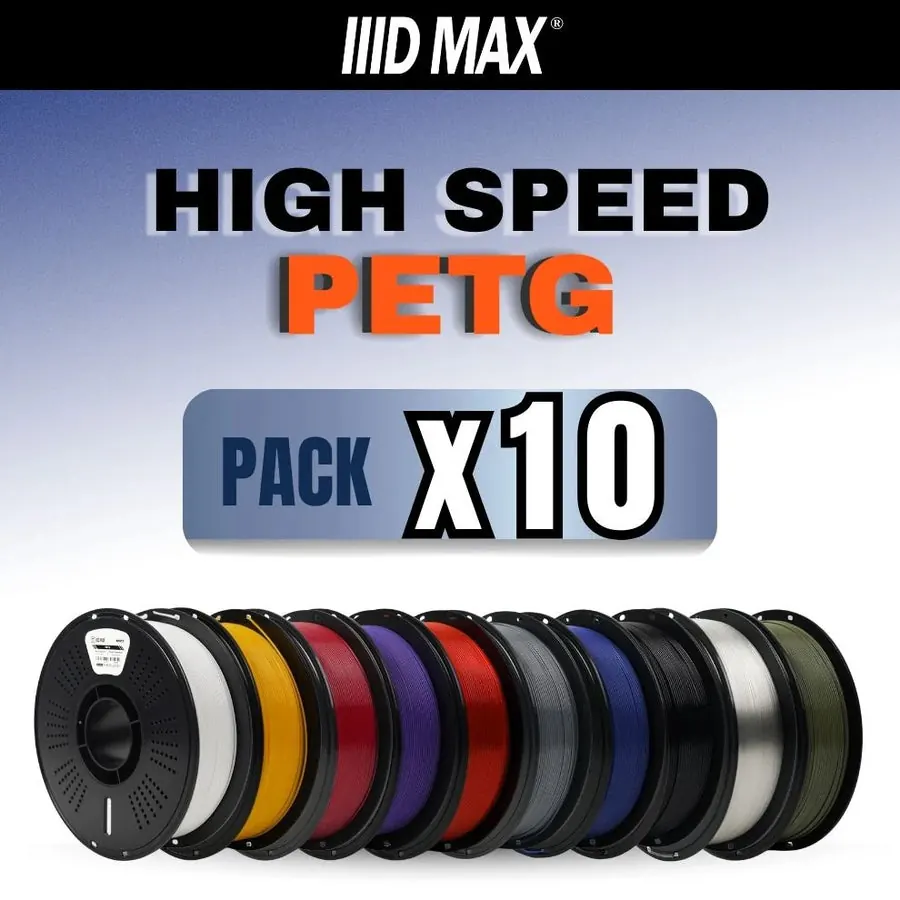
10 kg · any 10 colors
$236.80$149.90$14.99/kg
16 kg · any 16 colors
$378.88$223.84$13.99/kg
Single 1 kg spool · 16 colors
$23.68$23.68/kg
Buy at Supplies3D →Free shipping on filament to the lower 48 states · Ships from Miami in 1 to 2 business days · 3 to 7 business days in transit
| Spec | Detail |
|---|---|
| Material | PETG (polyethylene terephthalate glycol), high speed |
| Diameter | 1.75 mm ±0.02 mm |
| Spool weight | 1 kg (2.2 lbs) |
| Colors | 18+ in the packs · 16 in Fremover single spools |
| Heat resistance | About 85°C |
| Print speed | Up to 300 mm/s on capable printers |
| Enclosure | Not required |
| Outdoor use | UV stable |
| Packaging | Each spool vacuum-sealed with desiccant |
| Shipping | Free to the lower 48 states on filament orders · ships from Miami in 1 to 2 business days |
| Returns | 30 days from delivery, unused and in its original packaging |
| Use | Why this material works |
|---|---|
| Brackets, clips and mounts | High impact resistance: it bends slightly instead of snapping |
| Outdoor fixtures and garden parts | UV stable and shrugs off rain and humidity |
| Containers, bins and organizers | Tough walls that survive drops and daily handling |
| Parts in warm places | Keeps its shape up to about 85°C, well above PLA |
| Electronics enclosures | Low shrinkage keeps large flat panels flat, no enclosure needed |
| Light diffusers and lamp shades | Transparent colors pass light when printed with thin walls |
PLA is easier to print, but it softens in a hot car and cracks under hits. PETG keeps its shape at higher temperatures, bends a little before it breaks and stands up to sun and water.
Use PETG for brackets, clips, containers, outdoor parts and anything that gets handled every day. Keep PLA for models, prototypes and decor.
This PETG has a melt flow made for fast machines and supports up to 300 mm/s on printers that can reach it. On a standard printer it runs at normal speeds with the same toughness.
Because it shrinks very little as it cools, large flat parts stay flat, and you can print it on an open printer without an enclosure.
PETG comes from the same family of plastic as water bottles. The glycol added to it makes it easier to print, and it keeps what a bottle does well: it flexes instead of shattering, shrugs off moisture and does not sag on a warm day.
That is why it works for parts near electronics, inside a car in summer or outdoors, where plain PLA starts to soften around 60°C.
PETG sticks very hard to smooth PEI beds, so many makers print it on a textured plate or use a thin layer of glue stick as a release agent. It also strings more than PLA when the spool has absorbed humidity.
A dry spool and tuned retraction solve most problems. Our spools arrive vacuum-sealed, which helps with the first part; for an open spool that strings, dry it at 60°C for about 6 hours.
If you are trying PETG for the first time, a single Fremover spool lets you test colors and settings before you commit. Once PETG is part of your routine, a pack lowers the price of every kilogram, as you can see in the price per kg next to each option above.
| Material | Heat resistance | Enclosure | Best for |
|---|---|---|---|
| PLA+ | Softens around 60°C | Not needed | Models, prototypes, decor |
| PETG | About 85°C | Not needed | Functional and outdoor parts |
| ABS | About 100°C | Needed, bed at 90 to 110°C | Housings, mechanical parts |
Manufacturer ranges for our high speed PETG. Adjust 5°C at a time.
| Setting | Range | Where to start |
|---|---|---|
| Nozzle temperature | 230 to 260°C | 240°C |
| Bed temperature | 70 to 90°C | 85°C |
| Print speed | Up to 300 mm/s on capable printers | Your printer's normal PETG profile |
| Bed surface | Textured PEI, or glue stick on smooth PEI | Protects the plate when parts release |
| Drying | 60°C for about 6 hours | Only if the spool strings or crackles |
| Diameter | 1.75 mm ±0.02 mm | Standard 1.75 mm printers |
For functional parts, yes: PETG is tougher, handles heat up to about 85°C and resists sun. For easy printing and fine detail, PLA is still the simpler choice.
Parts that get used: brackets, clips, containers, tool holders and outdoor pieces. It is also a good middle ground between PLA and ABS.
Mostly because of stringing and very strong bed adhesion. Dry filament, tuned retraction and a textured plate fix the usual issues.
No. PETG prints well on an open printer, unlike ABS.
Start at 240°C on the nozzle and 85°C on the bed. The full range is 230 to 260°C for the nozzle and 70 to 90°C for the bed.
Pick your pack, choose your colors and get free shipping to the lower 48 states.